


TOLL SUBSCRIPTION PLANS
FOR PRIVATE INDIVIDUALS

ELECTRONIC TOLL PLANS
FOR PROFESSIONALS
BIP&GO
SERVICES
OUR PARTNERS
TOLL SUBSCRIPTION PLANS
FOR PRIVATE INDIVIDUALS
ELECTRONIC TOLL PLANS
FOR PROFESSIONALS
BIP&GO
SERVICES
OUR PARTNERS
20/08/2026
Planning a holiday in Italy? It’s a favourite destination for the French, who love its climate, diverse landscapes, cuisine, and rich culture (Rome, Florence, Venice). Travelling by car can be more cost-effective than taking the train or flying, especially for families. It’s also a more flexible option, letting you explore the country at your own pace. Before you set off, it’s essential to have your documents ready (ID card, driving licence, insurance) and to familiarise yourself with Italian regulations, especially regarding motorway tolls and Limited Traffic Zones (ZTL). What documents do you need? What are the motorway rules in Italy? Bip&Go, the electronic toll payment specialist, explains everything you need to know.
Driving to Italy requires you to carry several documents:
- A valid driving licence (a French licence is sufficient for a temporary stay),
- The vehicle registration document (number plate certificate),
- The rental agreement, if you’re driving a hire car,
- The insurance certificate or green card, proving your vehicle is covered by international third-party liability insurance.
It’s crucial to check that your French insurance policy covers you while driving in Italy. Also, to drive in Limited Traffic Zones, you’ll need a special permit in Italy. Make sure to arrange this if you plan to visit cities like Milan, Rome, Florence, or Naples.
Before planning your route in Italy, it’s important to be aware of a few key road rules. As in France, speed limits are: 50 km/h in towns, 90 km/h on secondary roads, and 130 km/h on motorways.
Road signs are very similar to those in France, with a few differences. Motorways are marked with green signs, while national roads use blue signs. ZTLs are clearly indicated with dedicated signs, restricting access for polluting vehicles at certain times of day.
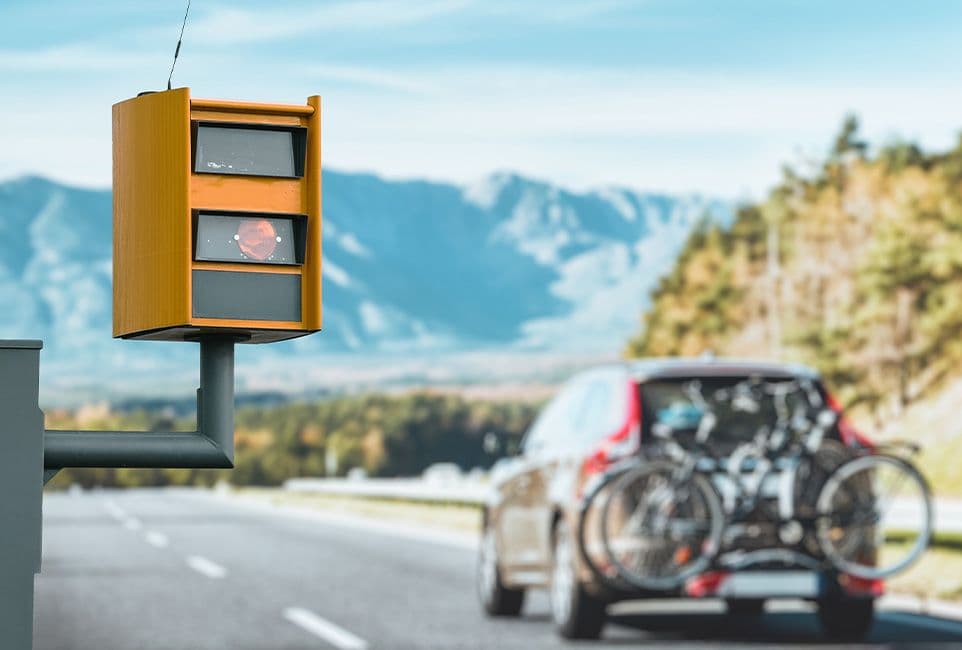
Be aware that exceeding speed limits can result in hefty fines, particularly on motorways or in urban areas. Speed cameras are common on major Italian roads, so it’s important to pay close attention to your speed.
Italian road signs are generally easy to understand: look out for signs indicating Zona Traffico Limitato (restricted access areas), Pedaggio (toll), Autovelox (speed cameras), and for each motorway service area.
Limited Traffic Zones are designed to restrict access for polluting vehicles (older diesels) during pollution peaks. Failing to comply can result in fines from €70 to €300. ZTLs are mainly found in the north, around Milan and Lake Como, Turin, Verona, and in Tuscany. Each zone has its own specific rules, so always check before entering.
There are several routes from France to Italy by car. The two most convenient are the A7 motorway via Lyon, which leads to Turin through the Fréjus Tunnel, and the A8, which links Nice to Genoa along the Mediterranean coast. Depending on your route, expect to pay between €30 and €50 in tolls to cross the Alps region.
Driving on the motorway with a Bip&Go badge in Italy
Want to know more about how electronic toll payment works in Italy? Bip&Go makes your journey easier by providing a toll payment badge compatible with the Italian Telepass system. This lets you drive through tolls without stopping, using the lanes reserved for Telepass subscribers. No more bother at toll booths or traffic jams—travel across Italy with ease.
The Bip&Go badge can be used on over 4,000 km of Italian motorways and gives you access to partner car parks in major cities. With the Bip&Go app, you can plan your route, estimate your travel costs, and track your expenses in real time.
Interested in a Bip&Go subscription to make driving in Italy even easier? Explore our range of subscription options and choose the one that suits you best.
Select your Bip&Go toll subscription!
You’ll need to show your driving licence, insurance certificate, vehicle registration document, and the car hire agreement if stopped by the police.
If you drive in a ZTL without authorisation, you risk a fine of between €70 and €300.
Yes, the Bip&Go badge works in many partner car parks across Italy.




Services for private individuals
© 2026 BIP&GO - All rights reserved
Services for private individuals

Services for professionals
Bip&Go services
About Bip&Go
© 2026 BIP&GO - All rights reserved


