


TOLL SUBSCRIPTION PLANS
FOR PRIVATE INDIVIDUALS

ELECTRONIC TOLL PLANS
FOR PROFESSIONALS
BIP&GO
SERVICES
OUR PARTNERS
TOLL SUBSCRIPTION PLANS
FOR PRIVATE INDIVIDUALS
ELECTRONIC TOLL PLANS
FOR PROFESSIONALS
BIP&GO
SERVICES
OUR PARTNERS
20/08/2026
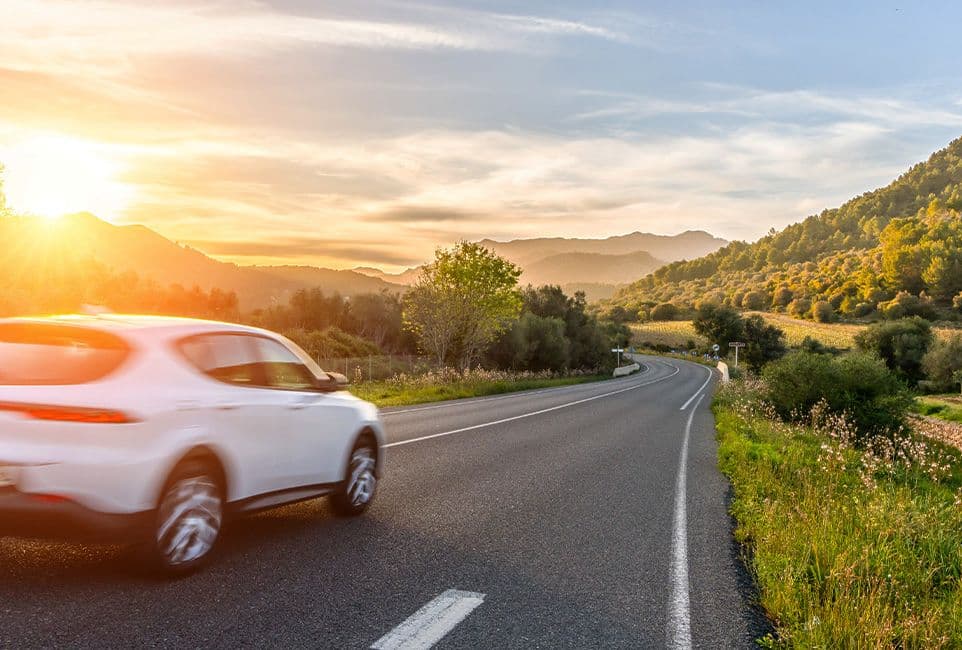
Planning a holiday to Spain soon? Depending on where you are in France, driving may be a more convenient option than flying. Before setting off, it’s essential to familiarise yourself with the local driving regulations and ensure you have all the necessary documents with you. To enter Spain by car, you must be able to present a valid national driving licence, your vehicle registration document, and proof of international insurance. Border checks may be carried out to verify these documents. If you’re planning a city break in places like Barcelona or Madrid, you may also need a Spanish environmental sticker to drive in low-emission zones (ZBE). Bip&Go explains everything you need to know.
Thinking of taking the motorway in Spain? Spain has a dense road network, making it easy for drivers to reach their destination, especially from central France. There are several main routes connecting France and Spain, such as the A9 motorway linking to the AP-7 towards Barcelona via La Jonquera, or the A63 from Bordeaux connecting to the AP-8, which leads to Bilbao. You can also take the A64 from Toulouse to Irún. On your road trip, you’re likely to pass through one of the main border crossings: La Jonquera, Biriatou or Le Perthus.
If you’re heading to Spain by car, you must have the following official documents with you:
| Document | Required / Recommended | Details and Formalities for Roadside Checks |
| Driver's License | Required | Drivers must present a valid driver's license. A French license is sufficient for temporary stays. |
| Registration Certificate (Carte Grise) | Required | Proves the vehicle is legally registered. Note: This document must match the vehicle being driven. |
| Proof of Insurance | Required | Your insurance policy must cover international travel. The insurance decal must be clearly displayed on the windshield. |
| Passport or ID Card | Recommended | Useful for identity checks. A passport is not required within the Schengen Area for EU citizens. |
| Crit'Air Eco-Decal (Vignette) | Recommended | Required to drive in certain low-emission zones in France. A Spanish equivalent also exists for major cities in Spain. |
When planning your route, it’s highly recommended to check the local driving rules and regulations for the Spanish region you’re visiting. Some areas may restrict access for high-emission vehicles. You should also be able to understand Spanish road signs (colours, symbols, etc.).
Speed limits in Spain are similar to those in France:
- 120 km/h on motorways,
- 90 km/h on secondary roads,
- 50 km/h in built-up areas.
Take care: speeding fines can reach up to €600, and you may lose points on your licence. Automatic speed cameras are common on main roads, so stick to the limits to avoid spoiling your holiday with a speeding ticket.
French drivers will find Spanish road signs easy to understand, as they are very similar. Green signs indicate a motorway, while blue signs mark a national road. Toll booths are shown by a blue symbol with the word "Peaje" or "Autopista".
Specific signs identify low-emission zones (ZBE), shown by a green symbol and access restrictions for high-emission vehicles. Speed limits are clearly displayed on round white signs with a red border.
Low-emission zones (ZBE) restrict access for the most polluting vehicles to help reduce urban pollution. These zones are mainly found around major cities such as Madrid and Barcelona. To enter, you’ll need an environmental sticker showing your vehicle’s emission level. Failing to comply can result in a fine of up to €200.
Travelling by car lets you discover Spain at your own pace, one stop at a time. The country boasts a rich cultural heritage and stunning scenery worth exploring. Take a break in a Barcelona hotel for a few days and visit Gaudí’s famous landmarks, such as Park Güell and the Sagrada Familia. Enjoy the beaches along the Costa Brava. Then head to the heart of the capital, Madrid. Explore the Prado Museum, Plaza Mayor and Crystal Palace in Retiro Park. Adventurous travellers can continue south to Andalusia, where many treasures await. Don’t miss Seville’s Plaza de España and Alcazar, or the Alhambra in Granada.
Wondering how to pay motorway tolls in Spain? You have several options: cash, bank card or electronic toll badge. Are you a Bip&Go subscriber and want to know more about toll badges in Spain? With your Bip&Go badge, you can drive through tolls without stopping, just as you do in France. Bip&Go is compatible with the Spanish electronic toll network (Via-T). Simply activate the Spain option in your app before you travel. With Bip&Go, you benefit from simplified billing and better tracking of your toll expenses.
The environmental sticker is mainly required around major Spanish cities. If you’re planning a seaside holiday on the Costa Brava (outside Barcelona), you may not need one.
The Crit’Air sticker in Spain is valid for the lifetime of the vehicle, provided European standards remain unchanged and the car’s number plate stays the same.
The Bip&Go badge can be used in certain partner car parks in some major Spanish cities.




Services for private individuals
© 2026 BIP&GO - All rights reserved
Services for private individuals

Services for professionals
Bip&Go services
About Bip&Go
© 2026 BIP&GO - All rights reserved


