


TOLL SUBSCRIPTION PLANS
FOR PRIVATE INDIVIDUALS

ELECTRONIC TOLL PLANS
FOR PROFESSIONALS
BIP&GO
SERVICES
OUR PARTNERS
TOLL SUBSCRIPTION PLANS
FOR PRIVATE INDIVIDUALS
ELECTRONIC TOLL PLANS
FOR PROFESSIONALS
BIP&GO
SERVICES
OUR PARTNERS
21/08/2026
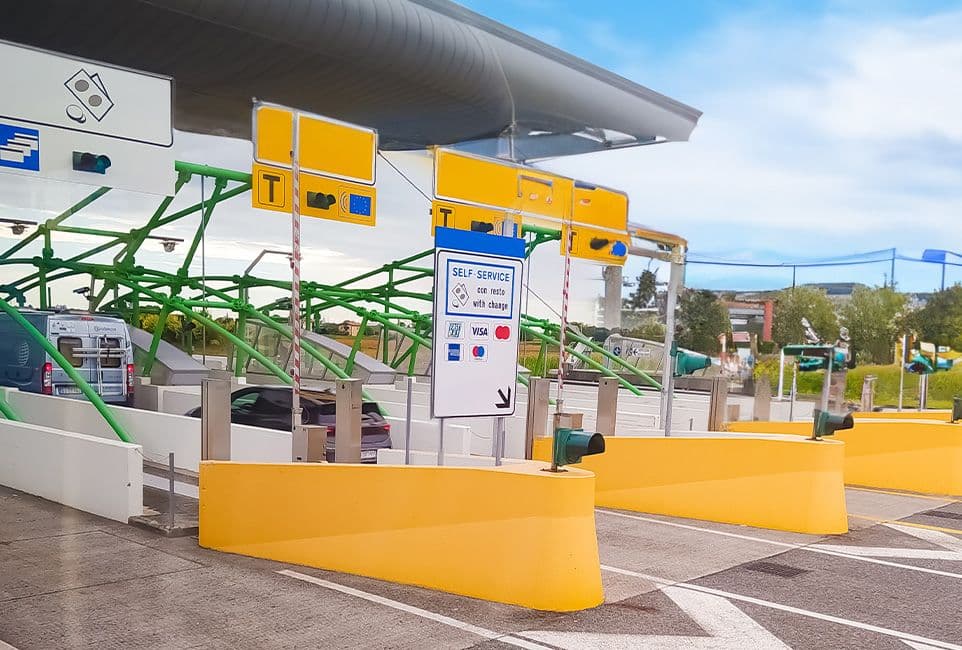
In Italy, motorways—known as autostrade—operate in a similar way to the network in France. The toll system uses barriers where drivers pay according to the distance travelled. Some expressways, however, require payment upon entry rather than exit. Unlike some neighbouring countries, Italy does not use a vignette system; instead, electronic tolling (Telepass) is widely used.
Did you know? The Italian motorway network stretches for around 6,943 km and sees annual traffic of over 80 million vehicle-kilometres. Which are the main motorways in Italy? How does toll payment work there? Is there an Italian electronic toll badge? Bip&Go, the European mobility specialist, explains everything you need to know.
In Italy, the motorways are marked with distinctive green motorway signs which stand out from the blue signs used for national roads. Each expressway is identified by a number preceded by the letter “A”, just like in France. For example, the A1 connects Milan and Naples, while the A4 links Turin and Venice.
The Italian motorway network is extensive, covering over 6,000 km and connecting the country’s major cities. Thanks to Italy’s varied landscape and mountain ranges, it’s common to cross bridges or tunnels on these fast routes. You’ll also find plenty of motorway service areas in Italy, just as you would on the French network.
Toll booths are easy to spot thanks to "Péage" or "Pedaggio" signs at both the entry and exit points of the motorways.
Italian motorways are designed to make travelling across the country easier and more efficient, providing direct routes to major cities.
The main expressways forming the Italian motorway network include:
| Highway Number | Route / Cities Served |
| A1 (Autostrada del Sole) from Milan to Naples | Milan, Bologna, Florence, Rome |
| A4 from Turin to Trieste | Turin, Milan, Verona, Venice |
| A14 (Adriatica) from Bologna to Taranto | Bologna, Bari, Rimini, Ancona |
| A22 (Autostrada del Brennero) from Modena to Brenner (Austrian border) | Modena, Verona, Bolzano |
| A7 (Serravalle) from Milan to Genoa | Milan, Genoa |
| A8 (Autostrada dei Laghi) from Milan to Chiasso (Swiss border) | Milan, Varese |
| A10 from Genoa to Ventimiglia (French border) | Genoa, Savona, Imperia |
| A12 from Genoa to Rome | Genoa, La Spezia, Pisa |
The A1, A4, and A22 motorways are vital for international transport and economic exchange, as they connect Italy’s largest cities with the rest of Europe.
It’s worth noting that 85% of the motorway network is managed by private companies, with Autostrade per l’Italia being the main operator. This company is responsible for maintenance and upgrades on the major routes.
Planning a road trip to Italy and want to know how the tolls work? Italy’s tolling system is quite similar to the one in France. When entering the motorway, drivers take a ticket showing their starting point. At the exit, this ticket is used to calculate the amount owed based on the distance covered. The cost depends on three main factors:
- The number of kilometres travelled,
- The vehicle class (categories 1 to 5: passenger car, motorhome, HGV, etc.),
- The motorway category (higher for routes with tunnels).
Some routes—such as the A36—use physical toll barriers, where drivers pay a set amount without a ticket. You can estimate your journey cost in advance by entering your route into your Bip&Go app.
As with French motorways, various payment methods are accepted at Italian tolls:
Telepass is by far the fastest and most convenient option, especially for frequent motorway users. Subscribers can use dedicated electronic toll lanes at the barriers. Note: cash payments are not accepted in Telepass lanes. Also, unlike Switzerland and Austria, Italy does not use a vignette subscription system.
Are you a Bip&Go subscriber or looking to sign up? Great news! The Bip&Go badge is compatible with the Telepass electronic toll system in Italy. This means you can travel safely on Italian motorways and city ring roads during your holidays, without stopping at toll barriers. You’re also entitled to use the dedicated lanes for Telepass subscribers, helping you avoid traffic jams.
Please remember to activate the Italy option on your Bip&Go account for your badge to work in Italy. Your Bip&Go badge also gives you access to selected partner car parks, making it easier to park in city centres.
Find out more about Bip&Go in Italy
Plan your journey with your Bip&Go app and run a route simulation to access all the information you need (cost, service areas, and more).
With your badge, there’s no need to prepare your payment method before reaching the toll barrier—payment is automatic. Save time by avoiding queues and not having to stop at the tolls.
Simply log in to your customer area via our website or the Bip&Go app to activate the “travel in Italy” option.




Services for private individuals
© 2026 BIP&GO - All rights reserved
Services for private individuals

Services for professionals
Bip&Go services
About Bip&Go
© 2026 BIP&GO - All rights reserved


